A static poster buys you a 30-second glance. Something a visitor can touch buys you five minutes, and five minutes is where a conversation becomes a lead.
The gap is measurable. Interactive elements keep attendees in a booth two to three times longer than static displays, and industry research puts the dwell time lift from interactive displays, AR and VR demos, and gamified elements at 30 to 40%, with lead capture up as much as 35%.
Covered here:
- Hands-on demos and micro-demos
- AR and VR, with real costs
- Gamification and photo moments
- Layout that supports interaction
- Staff, data capture, and follow up
We build interactive exhibits at Local Exhibits, so the numbers below reflect what these things actually cost to produce.
Start With Purpose, Not Technology
The most common mistake is buying a VR headset and then working out what to put on it.
Define What the Booth Is For
Write down the outcome first. Then choose the interaction that serves it.
| Objective | Best-Fit Interaction |
|---|---|
| Qualify high volume | Gamified lead capture, quiz stations |
| Explain a complex product | AR overlay, product configurator |
| Show something unshippable | VR walkthrough, projection mapping |
| Build trust in a physical product | Tactile hands-on demo |
| Extend reach beyond the hall | Photo moment, live streaming |
A clear strategy aligns booth design with measurable outcomes. Without one, you end up with three unrelated activations competing for the same floor space.
Know Your Audience First
Gamification works well for broad traffic. For narrow, senior-level B2B audiences, a sophisticated product configurator or a personalized assessment lands better than a spin wheel that feels out of context in front of a procurement director.
Pro tip: if you cannot explain in one sentence why a given interactive element helps a visitor decide whether to buy from you, it belongs at a consumer expo, not your booth.
Hands-On Product Experiences
The lowest-tech option on this list, and often the most effective.
Let People Touch It
Attendees consistently prefer hands-on experiences over static displays. Handling a product builds credibility and curiosity in a way no video can, and information retention rises sharply when someone has used the thing themselves.
Formats that work:
- Touch-and-try stations where visitors operate live product
- Material sample walls for anything where finish or texture matters
- Working equipment running at intervals through the day
- Comparison stations placing your product beside the alternative
- Assembly or setup challenges, especially for anything sold on ease of use
Design the Station Properly
A demo table crammed against the back wall gets ignored. Put hands-on stations where a small crowd can gather without blocking the aisle, and give each one a staffer who knows the product cold.
Two or three small stations usually beat one large one. Parallel conversations mean more throughput across a three-day show.
Micro-Demos Respect Tight Schedules
Convention schedules are brutal. A 20-minute presentation asks more than most attendees can give.
Keep It Under Two Minutes
Micro-demos of under two minutes respect tight schedules while still informing the visitor. They also remove the commitment anxiety that stops people from stopping.
Structure:
- The hook, 10 seconds. Why this matters to them
- The demonstration, 60 to 80 seconds. One capability, done well
- The question, 20 seconds. What are you using today?
That last step converts a demo into a qualification conversation.
Run Longer Demos on a Schedule
For products that genuinely need more time, post a schedule and run full demos every 20 to 30 minutes. A visible start time gives passersby a reason to come back, and a small crowd pulls in the next one.
Live demonstrations remain one of the most reliable lead generators on any show floor, because they answer the question every buyer is actually asking: does this work?
AR and VR, With Real Numbers
The highest-impact and highest-cost options. Worth it in specific situations.
Augmented Reality
AR layers digital content onto physical products, letting visitors see inside complex machinery or interact with a digital twin.
| Approach | Cost |
|---|---|
| AR content development | $3,000 to $12,000 depending on complexity |
| Tablet kiosk hardware | $400 to $1,200 per unit |
Tablet-based AR kiosks give you a controlled experience with no dependency on the visitor’s own phone. Best suited to large, complex, or invisible products: HVAC systems, industrial equipment, SaaS workflows, medical devices.
Virtual Reality
VR is the highest-investment, highest-immersion option. A three- to five-minute headset session creates an extremely memorable brand interaction.
| Component | Cost |
|---|---|
| Standalone headsets | $500 to $650 each |
| Recommended units | 2 to 4 for volume |
| Content development | $5,000 to $20,000+ |
VR earns its cost when you are selling something that cannot travel: a factory, an installed system, a facility tour, a location three thousand miles away.
Plan the Timeline
Custom AR or VR content commonly needs 16 weeks or more. Work backward from your show date.
Two practical notes: headsets and touchscreens used by hundreds of people need a visible cleaning routine between uses, which measurably affects whether attendees are willing to try them. And never assume the venue’s power supply. VR rigs, displays, and charging stations all pull different wattages, and electrical gets ordered weeks in advance.
Gamification and Contests
Games tap the competitive streak that most trade show attendees have and will not admit to.
What Works on a Show Floor
- Digital leaderboards with short, high-speed micro-challenges
- Spin-to-win wheels that capture lead data in exchange for a giveaway
- Trivia walls built around industry knowledge
- Instant-win games for fast throughput at busy periods
- QR code scavenger hunts hidden around your booth or the hall
- AR games merging digital play with the physical space
Scavenger hunts work especially well in small footprints, where you need to hold people in a tight space.
Build Qualification Into the Game
The questions inside the game are the real product. A quiz that asks about company size, current vendor, and timeline qualifies the lead while the person is still enjoying themselves.
Reward-based challenges also incentivize visitors to hand over contact details willingly, which produces cleaner data than a badge scan alone.
Photo Moments and Social Sharing
Turn attendees into distribution.
Build for the Camera
Create dedicated zones with studio-quality lighting designed for content people actually want to post. A branded backdrop, an oversized prop, a light installation, anything worth standing in front of.
Add a show-specific hashtag and a printed frame, and social sharing becomes a measurable channel rather than a happy accident. Every post carries your brand to an audience that never walked the hall.
Live Stream the Booth
Stream demos, interviews, or product reveals from the floor to LinkedIn or Instagram. It extends reach past the venue and gives attendees something to rewatch later.
It also turns quiet floor hours into productive ones, which matters on the final afternoon when foot traffic thins.
Digital Tools and Touchscreens
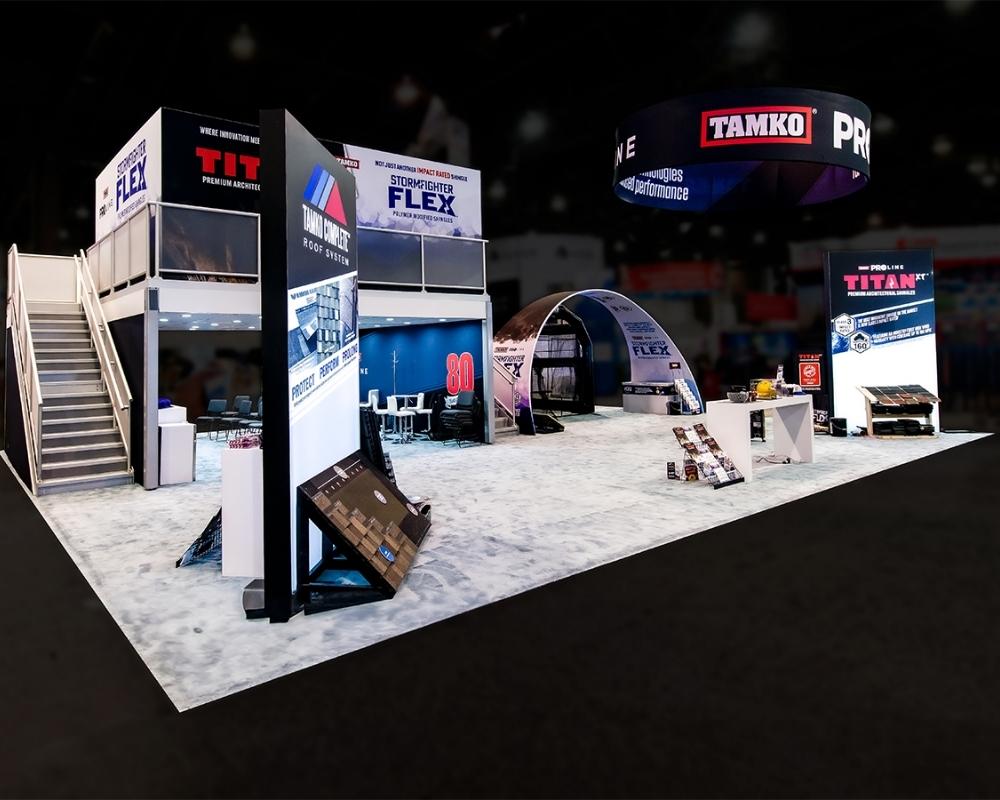
The workhorses. Less flashy than VR, more used.
| Tool | Best Use |
|---|---|
| Touchscreen kiosks | Self-guided product exploration, lead capture |
| Product configurators | Complex or customizable offerings |
| LED video walls | Visual storytelling in high-traffic areas |
| Interactive floor displays | Motion-activated visuals that pull people in |
| Live polling walls | Real-time audience participation |
| Projection mapping | Dynamic content on 3D booth surfaces |
| RFID or NFC badge triggers | Personalized content when a visitor approaches |
Touchless options have staying power beyond hygiene. Around 82% of attendees now prefer touchless check-ins, and gesture control or QR-triggered content removes friction from the first interaction.
Every digital element should end with a next step. A kiosk that finishes with “email these results to yourself” converts engagement into a lead record without anyone asking.
Design the Booth Around Interaction
Interactive elements fail when the layout fights them.
Layout Essentials
- Inviting entry points with no counter blocking the path
- Clear sightlines so a passing attendee sees the activity inside
- Room to gather around each station without clogging the aisle
- Front hooks like a dynamic LED wall or AR marker that trigger curiosity from the aisle
- Separate audio zones so a VR station does not bleed into a meeting
Booth location matters too. Strategic placement near main aisles, entrances, or paths to food and session rooms increases the traffic your interactive elements have to work with.
Signage Still Does the Heavy Lifting
Clear signage remains critical. A visitor needs to understand your value proposition from 20 feet before they will walk in to try anything.
High-quality images and one readable headline do more for booth traffic than any gadget. The interaction converts the people your graphics brought in.
Our design team plans power routing, sightlines, and gathering space into the drawings, because tech taped onto a finished booth always looks like tech taped onto a finished booth.
Staff Make or Break It
The most sophisticated activation fails if nobody invites people to try it.
Train for Interaction
Booth staff need to do three things well:
- Invite. “Want to try it?” outperforms waiting for someone to approach
- Guide. Walk the visitor through without taking over
- Convert. Turn the experience into a qualifying conversation
Train the team to read different personality types. Some visitors want to be shown, others want to be left alone to explore, and pushing the wrong approach loses both.
Align everyone on messaging and goals before the doors open. Five staffers describing the product five ways undoes whatever the interactive element built.
Capture the Data, Then Use It
Interactive booths generate something static ones cannot: behavioral data.
What to Track
| Element | Metric |
|---|---|
| AR or VR | Dwell time, session completions, repeat users |
| Touchscreens | Click paths, time per product, exit points |
| Games | Interactions per day, completion rate |
| Social activations | Shares, tags, hashtag reach |
| RFID or NFC | Who visited what, when, how long |
Most of these tools ship with analytics dashboards. Assign one person to review the numbers daily during a multi-day show so you can adjust staffing and placement on day two rather than after the fact.
Plan Follow-Up Before You Travel
Collecting engagement data is pointless without a plan for it. Decide in advance who owns which segment, what the first message says, and when it goes out.
A visitor who spent four minutes in a VR demo is a different lead than a badge scan at the counter. Treat them differently. Our guide to measuring booth performance covers the metrics that survive a budget review.
Budget and Lead Times
What to plan for, by ambition level.
| Tier | Elements | Budget | Lead Time |
|---|---|---|---|
| Entry | QR activations, tablets, prize wheel | $1,000 to $5,000 | 2 to 4 weeks |
| Mid | Touchscreen kiosks, configurator, photo wall | $5,000 to $20,000 | 6 to 10 weeks |
| High | Custom AR, VR content, projection mapping | $20,000 to $60,000+ | 16+ weeks |
Touchscreen kiosks, tablet-based AR, and compact projection mapping all work in a 10×10 or 10×20 footprint. You do not need an island to be interactive.
Stage backup hardware on site. A dead screen on day one costs more than the spare unit would have.
Interactive Ideas by Booth Size
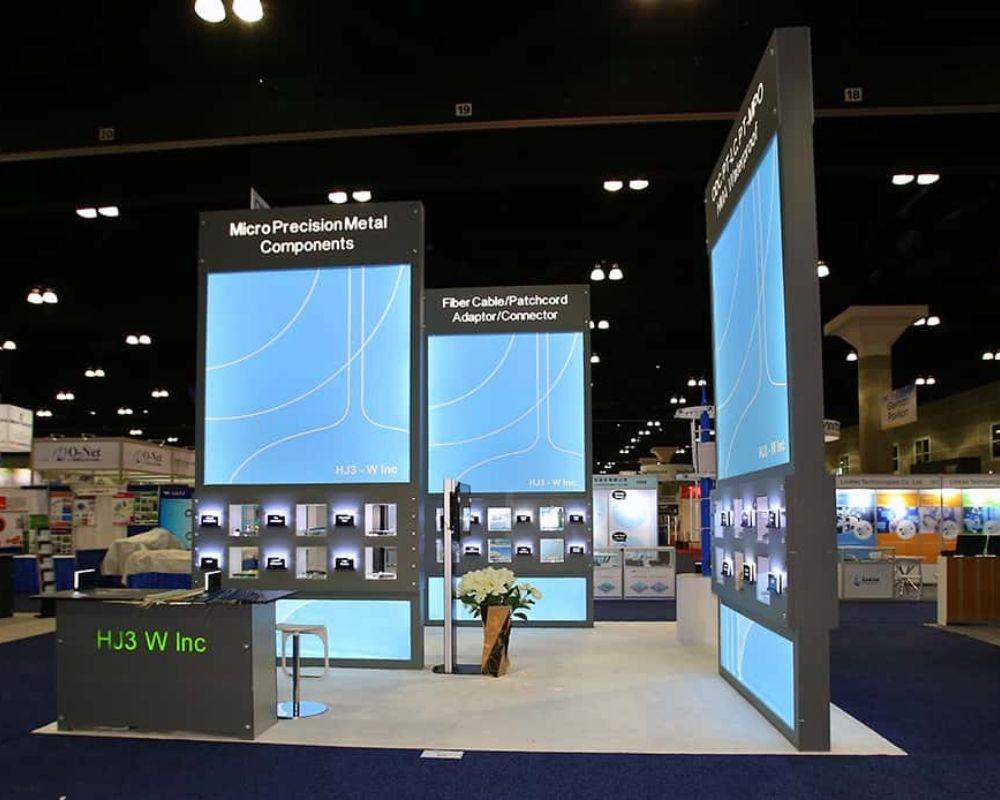
A 10×10 can be interactive. It just has to pick one thing and do it properly.
What Fits Where
| Footprint | Realistic Interactive Elements | Skip |
|---|---|---|
| 10×10 | One touchscreen or tablet station, QR activations, a compact photo backdrop | VR, video walls, seated demos |
| 10×20 | Touchscreen plus a hands-on product table, prize wheel | Multiple simultaneous activations |
| 20×20 island | Two or three demo pods, a photo moment, AR station | More than four competing zones |
| 30×30 island | Demo theater with seating, VR bay, interactive wall, photo installation | Nothing, within reason |
The constraint at smaller sizes is not budget. It is gathering space. An activation that draws five people into a 10×10 has just closed your booth to everyone else.
Small Booth, Big Impact
Four ideas that work in a tight footprint:
- Wall-mounted touchscreen. Vertical, no floor space consumed
- QR scavenger hunt that sends visitors around the hall and back
- Single hands-on product on a slim pedestal with one staffer
- Vertical photo backdrop on the side wall rather than the back
Pair any of those with dynamic lighting and you have a visually appealing booth that punches above its square footage.
Design Elements That Grab Attention
Interaction converts. Design is what gets people close enough to convert.
The Attention Sequence
A visitor walking your aisle makes three decisions in about four seconds:
- Notice. Height, light, motion, or contrast
- Understand. Your brand message in one readable line
- Approach. Something visibly happening that looks worth joining
Skip any step and the next one never happens. Most booths fail at step two, where a beautiful structure says nothing a passerby can act on.
Elements That Do the Work
- Dynamic lighting. Color shifts, animated LED strips, or spotlighting that changes through the day
- Motion. Anything moving pulls the eye harder than anything static
- Height. A tower or hanging sign makes you findable from across the trade show floor
- Product displays at eye level. Not tucked behind a counter
- Visible activity. People already engaging is the strongest signal there is
Crowds attract crowds. A demo with four people watching draws the next four without anyone asking.
Keep the Brand Identity Consistent
Interactive features should look like they belong to the booth, not like they were rented separately. Match screen bezels, kiosk wraps, and game graphics to your color palette and typography.
A custom trade show booth designed with the technology built in reads as one environment. Tech added late reads as an afterthought, and attendees register that difference even when they cannot name it.
Build a Photo Booth People Actually Use
Photo moments get dismissed as a consumer tactic. They work in B2B too, and they cost less than almost anything else on the interactive list.
What Makes One Work
The bar is simple: would a professional attendee post this without embarrassment?
- Studio-quality lighting. The single biggest difference between a used photo wall and an ignored one
- A reason, not just a backdrop. An oversized prop, an unusual material, a light installation
- Instant delivery. Emailed or texted within seconds, which doubles as lead capture
- Subtle branding. A logo in the corner, not a wall of them
- A show hashtag printed at eye level
Why It Earns Its Space
Every photo posted carries your brand to people who never attended. It also creates a low-pressure entry point: someone who will not approach a sales rep will happily stand in front of a camera, and that is the start of a conversation.
Prize draws tied to posting extend the reach further. Offer exclusive deals or exclusive content in exchange for a tagged post, and you convert a photo into a lead record.
Real World Examples Worth Copying
Patterns that repeat across industries, adapted to different products.
The Configurator Booth
Manufacturers of complex or customizable products put a configurator on a large touchscreen. Visitors build their own version, see pricing implications, and email the result to themselves.
Why it works: the output is personally relevant, so the follow-up email references something the prospect built rather than something you sent.
The Sneak Peek Booth
Brands with an unreleased product create a curtained or badge-gated area showing it early. Access requires a badge scan and a short conversation.
Why it works: exclusivity generates interest without discounting anything, and the gate qualifies visitors before they see it.
The Problem Diagnosis Booth
Service companies run a short assessment on a tablet. Answer eight questions, get a scored result against industry benchmarks.
Why it works: it starts conversations at the right depth, since the visitor has already told you what is broken.
The Working Line Booth
Equipment manufacturers run the machine, continuously, at a scale visitors can stand beside safely.
Why it works: nothing else proves throughput, noise level, or footprint the way watching it does.
Each of these creates memorable experiences by being useful, not by being loud. That distinction is what separates innovative strategies from gimmicks that draw a crowd of people who will never buy.
Turn Interaction Into Valuable Leads
Engagement that does not produce a contact record is entertainment.
Build Capture Into Every Element
Every interactive station should have a natural moment where contact details get exchanged:
| Element | Capture Moment |
|---|---|
| Configurator | “Email me this build” |
| Assessment or quiz | “Send my results” |
| Game or leaderboard | Entry registration |
| Photo moment | Instant delivery to phone |
| VR or AR demo | Badge scan to queue |
| Live demo | Follow-up material request |
None of those feel like a form. That is the point. Lead capture works best when it is the obvious next step in something the visitor already wanted.
Score by Behavior
Interactive booths generate signal that badge scans cannot. Someone who completed a five-minute VR session and asked two technical questions is a different prospect than someone who spun a wheel on the way past.
Tag them differently at the booth, then treat them differently in follow up. Behavior-based scoring consistently outperforms title-based scoring for trade show leads.
Follow Up on the Experience
Reference what they did, not that you met. “Here is the configuration you built at our booth” gets opened. “Great to meet you at the show” does not.
That specificity is only possible if someone captured the context during the interaction, which is why lead capture design belongs in the booth conversation from the start rather than as a last-minute add-on.
Our team plans the capture flow alongside the structure, so the technology, the layout, and the follow-up sequence are designed as one system rather than three. If you want expert guidance on which interaction fits your target audience and your footprint, that conversation is where we start.
Give People Something to Do, and Local Exhibits Will Build It
A booth is not just a space with your logo on it. The exhibitors who convert traffic give visitors something to do with their hands, then have someone ready to turn that into a conversation.
Before your next show:
- Pick one interaction tied to a specific objective
- Design the layout around it, not the other way round
- Order power and internet against the advance deadline
- Start custom AR or VR content 16 weeks out
- Train staff to invite, guide, and qualify
- Decide the follow-up plan before you travel
We handle design, fabrication, technology integration, install, and on-site support so the interactive parts still work on day three. See our work, then tell us what you want visitors to experience.
Frequently Asked Questions
What are some interactive ideas for a trade show booth?
Hands-on product stations, micro-demos under two minutes, AR product overlays, VR walkthroughs, digital leaderboards, prize wheels, photo walls, and touchscreen configurators.
How to make a booth more interactive?
Give visitors something to do with their hands. Start with one element tied to a clear goal, then design the layout and staffing around it.
How to make a trade show booth stand out?
Height, layered lighting, one message readable at 20 feet, an open entry, and an activity visible from the aisle that people can join immediately.
What are some good interactive games for trade shows?
Timed micro-challenges with a leaderboard, branded trivia, digital prize wheels, QR scavenger hunts, and AR games that tie into your product.